



Creative Bloq Verdict
The Evercade Nexus is the best version of what Evercade has been building towards. It’s comfortable, well-made, and easy to use, and it comes with a big screen, twin sticks, and the full cartridge library from day one. Banjo-Kazooie in the box shows what it can do in 3D, while the 8-bit and 16-bit classics that built the brand are still right at home. An easy recommendation.
Reasons to buy
- +
Big, bright screen that makes 3D and mid-90s pixel art look crisp
- +
Banjo-Kazooie bundled in the box, with native widescreen, 60fps and Stop ’n’ Swop content
- +
Plays the entire existing Evercade games library
- +
EverSync lets a second Nexus play a game from just one cartridge
Reasons to avoid
- -
No HDMI, so no TV play
- -
Lacks sleep mode
- -
Not OLED, so no deep blacks
Why you can trust Creative Bloq Our expert reviewers spend hours testing and comparing products and services so you can choose the best for you. Find out more about how we test.
Price: £169.99
Display: 5.89-inch IPS
Display: 840 x 512 resolution, 500+ nits
Processor: Quad-core 1.5GHz
Memory: 512MB, 4GB storage
Battery: 5,000mAh, rated 5+ hours
Controls: D-pad, face buttons, twin analogue sticks, bumpers and triggers
Connectivity: Wi-Fi 6, Bluetooth audio, 3.5mm
Dimensions: 215 x 111 x 34mm / 410g
Included game: Banjo-Kazooie Double Pack
Evercade Nexus is the retro game brand cracking its knuckles, stretching and embracing an even larger catalogue of retro games. Evercade has established itself as the easy entry point to retro gaming. It’s the antidote to wasting afternoons lost to getting ROMs running and fiddling with settings, and as much as I love ways to play like the Sinclair Gamer Card, I also enjoy the ease of Evercade’s cart approach, and I’ve been a fan since the first Evercade EXP.
With the Nexus, we have a retro game console that can play all the existing properly licensed games in the Evercade library, with authentic emulation and physical cartridges that scratch the collector itch, while ushering us into a ‘new’ 3D era. You pop a cart in, and you play.
So this is 'next gen', then, in the most Evercade way, with new cartridge collections stretching up to around 1998, proper 3D alongside the pixels, and a handheld that looks and feels like it belongs in 2026. I got my first hands-on with the console at the Nexus community launch in September, where I got to play Doom and Banjo-Kazooie, and I also got context for Nexus, as the room was lined with old Evercade consoles leading up to this moment. You can find many of these in our best retro consoles guide.
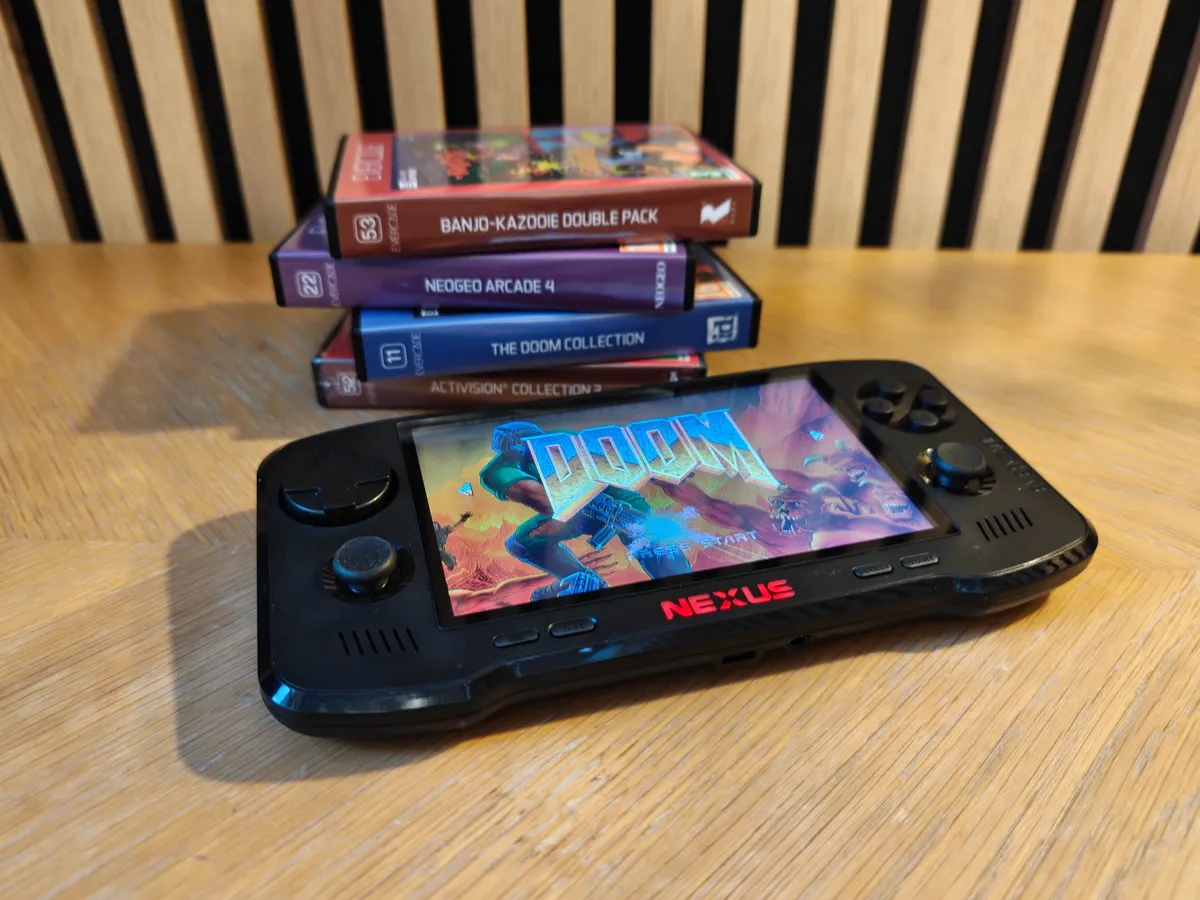
Nexus is a new shape for Evercade
First thing to know: the Nexus is much bigger than the Evercade EXP and the newer EXP-R and can feel a little chunky compared to the older model. The Nexus is a proper handheld in the vein of the Nintendo Switch, not a jacket-pocket gadget. That said, the Nexus is still smaller and lighter than a Nintendo Switch 2; for context, it’s about the size of the Switch 2 display, and I've been happy playing for hours at a time.
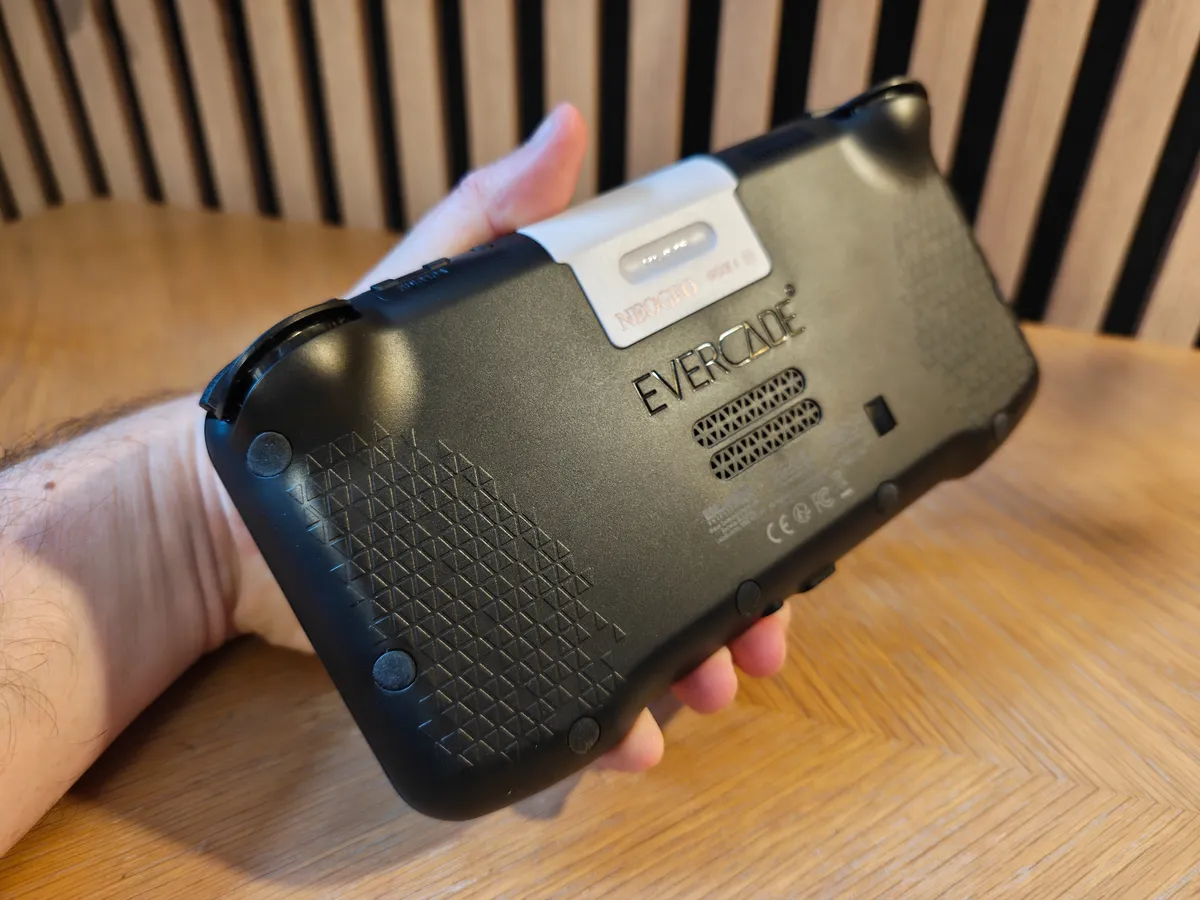
The design has some fun touches you expect from a Sony console. The rear grips feature a subtle mesh of raised 'A' symbols that nod to the Evercade logo, and the textured rubber pads sit where your hands land to keep it from shifting. For me, and even though I love it, the Switch 2 can feel slippery in handheld mode, as its slimmer design and smaller, curved finger bridges can be too subtle. The Nexus doesn't move in the hand; it’s bulkier, yes, but also more solid in the grip.
Up front is the 5.89-inch IPS display, with controls arranged around it as you expect from a modern handheld. Evercade has opted for symmetrical analogue sticks rather than the Xbox and Nintendo offset layout, and I'm a fan. It feels closer to a PlayStation pad, and it suits 3D games well while also making 2D games easy to play.
Under the display, you get a quad-core 1.5GHz processor, 512MB of RAM, and 4GB of storage, plus Wi-Fi 6 for system updates. The 5,000mAh battery lasts more than five hours and charges via USB-C. You also get Bluetooth headphone support, a 3.5mm jack and front-facing stereo speakers.
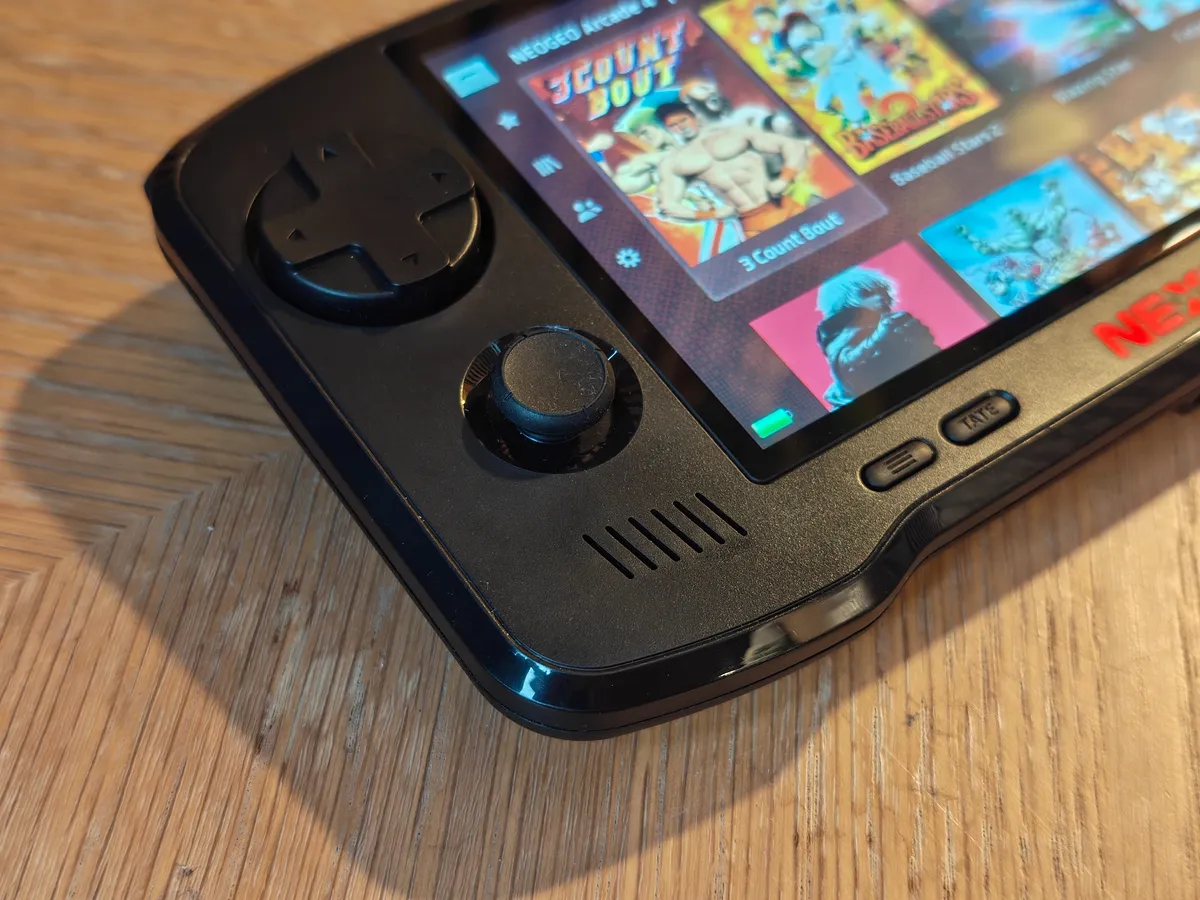
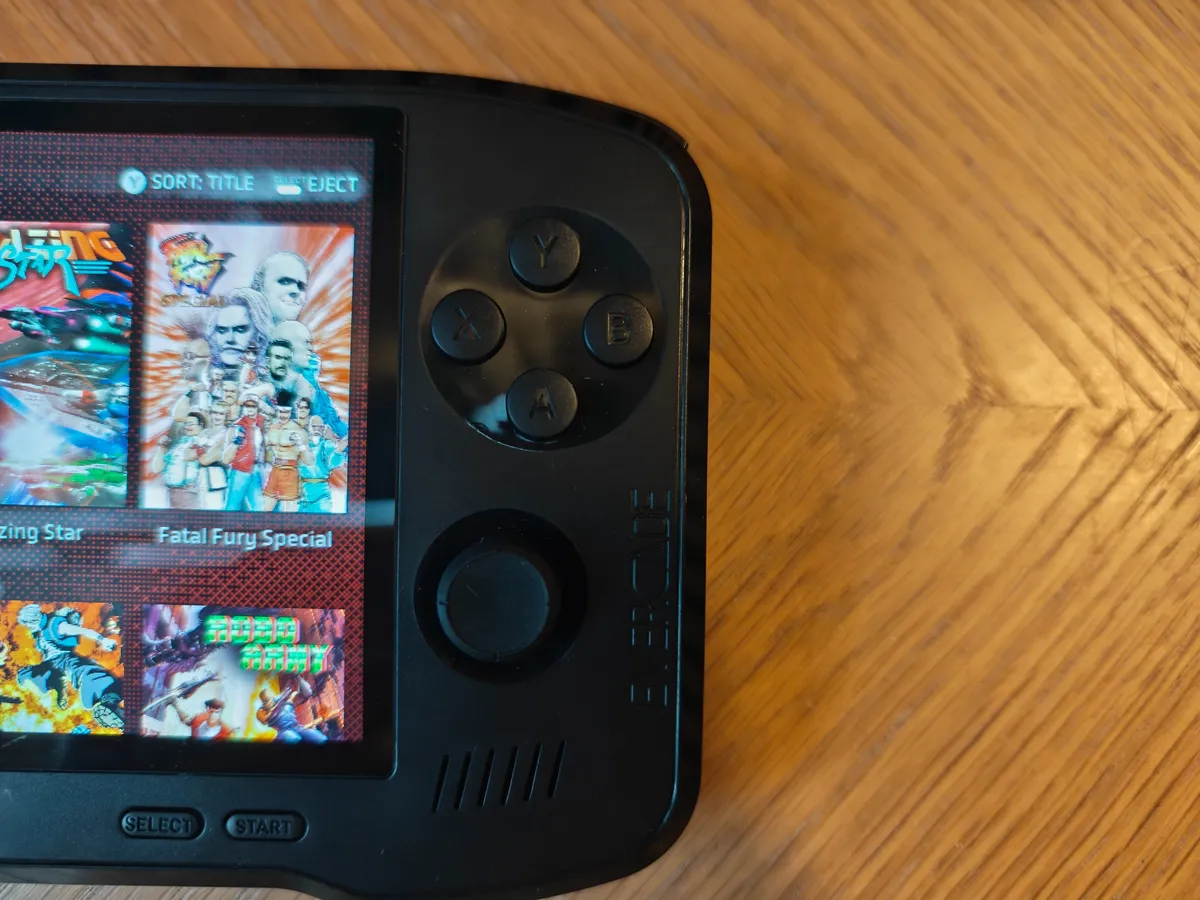
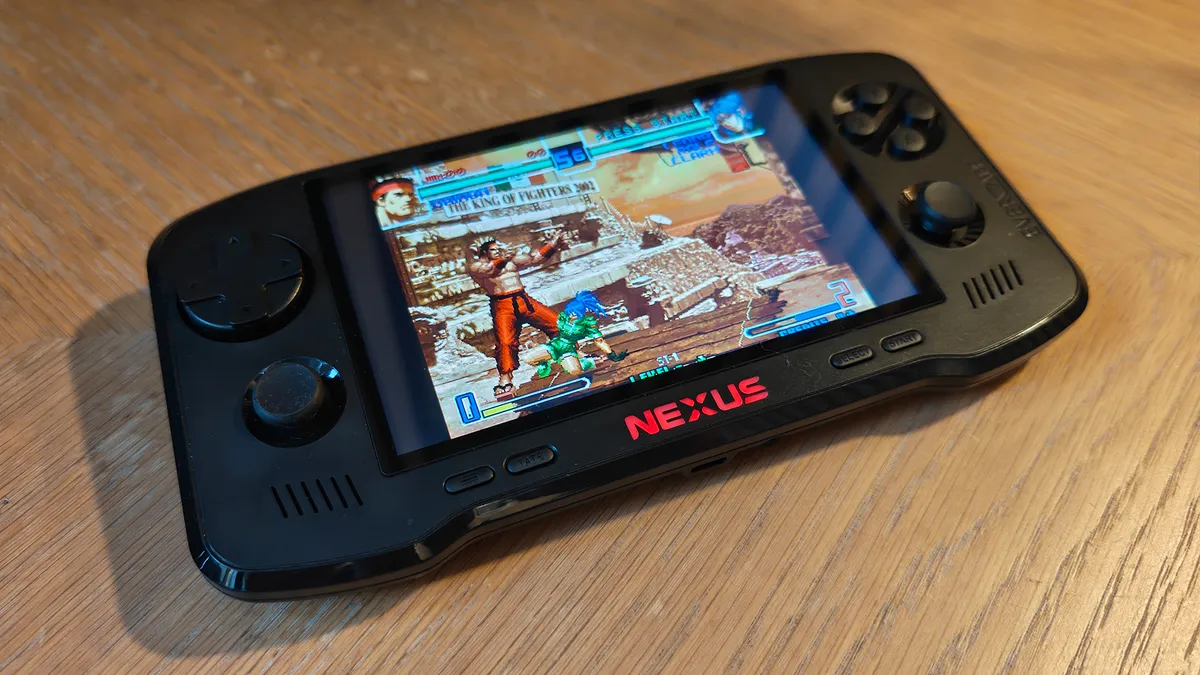
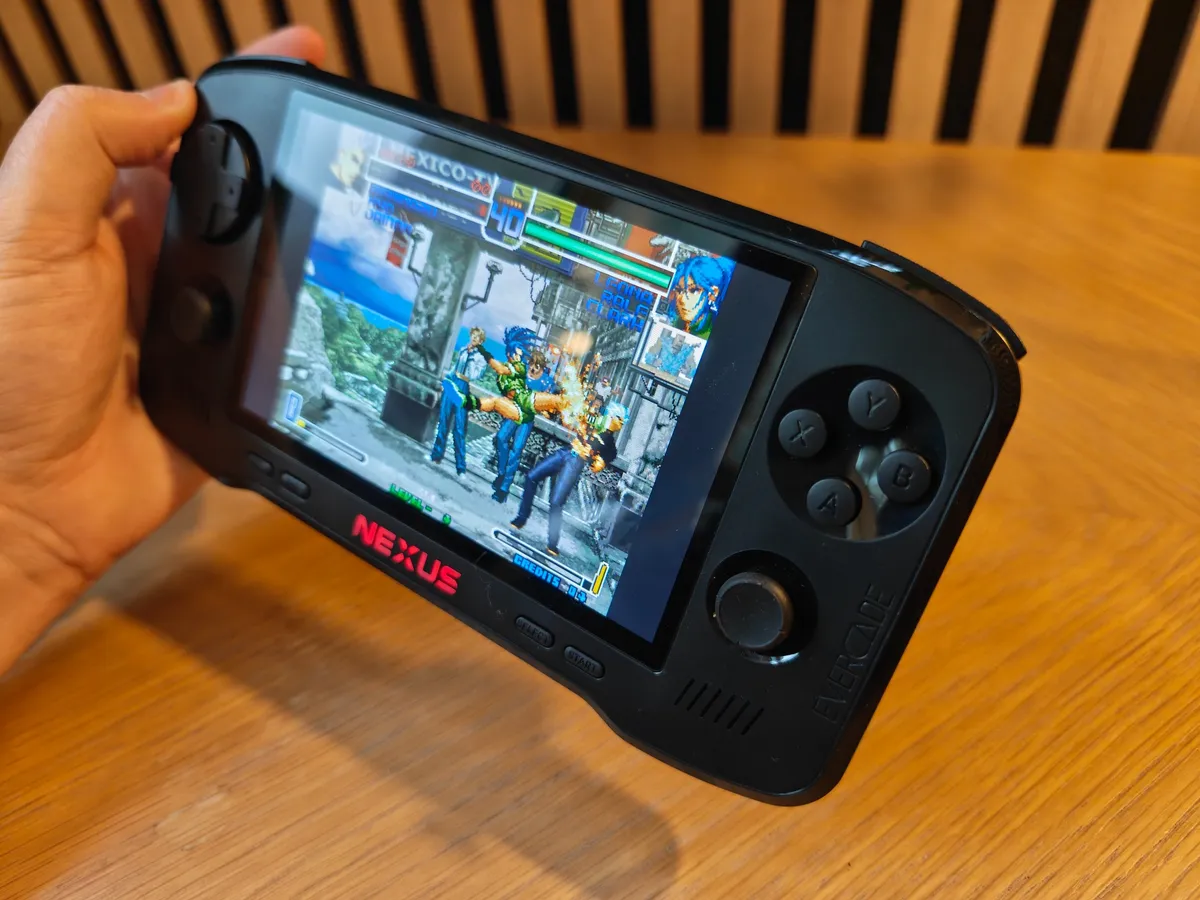
The D-pad, you see, is also symmetrically placed opposite the face buttons, but it’s also a big step up from the older EXP's pad. It's light and responsive, which is exactly what you want for fighting games, and I've sunk plenty of time into King of the Fighters 2002 on it, and it's still going well. Switching to the classic controls for the new Atari collections feels natural, too.
The buttons are a touch clicky and light; they don't have the premium feel of pricier handhelds. Next to a Switch 2, you can see where the money went. At this price, and for the games it’s designed to play, from Doom to Activision Decathlon, that's fair, and the controls never distract.
Nexus is bigger, brighter and ready for 3D
The screen is the Nexus's biggest upgrade and one reason for its size, because embracing 3D and the more complex pixel art of games from the mid-90s onward demands a larger screen. It's a 5.89-inch IPS panel at 840 x 512, rated at over 500 nits. It isn't OLED, so don't expect the deep blacks of a premium handheld, but I came away impressed. Colours pop, contrast is solid and older games look crisp without losing their grit. The simulated CRT and other retro game effects on many cartridges sit nicely, too.
Banjo-Kazooie comes bundled in the box, and it's a brilliant showcase. Banjo-Kazooie and Banjo-Tooie both get new native ports with widescreen support, higher resolution and 60fps, and that second analogue stick transforms how they play. These aren't old N64 ROMs run through an emulator. They've been nicely reworked, with modern control options and Stop 'n' Swop content. It's one of the best reasons to buy the Nexus and joins the likes of the recent Croc 2 remaster in showing how these old 3D platfomers can be improved on new hardware..
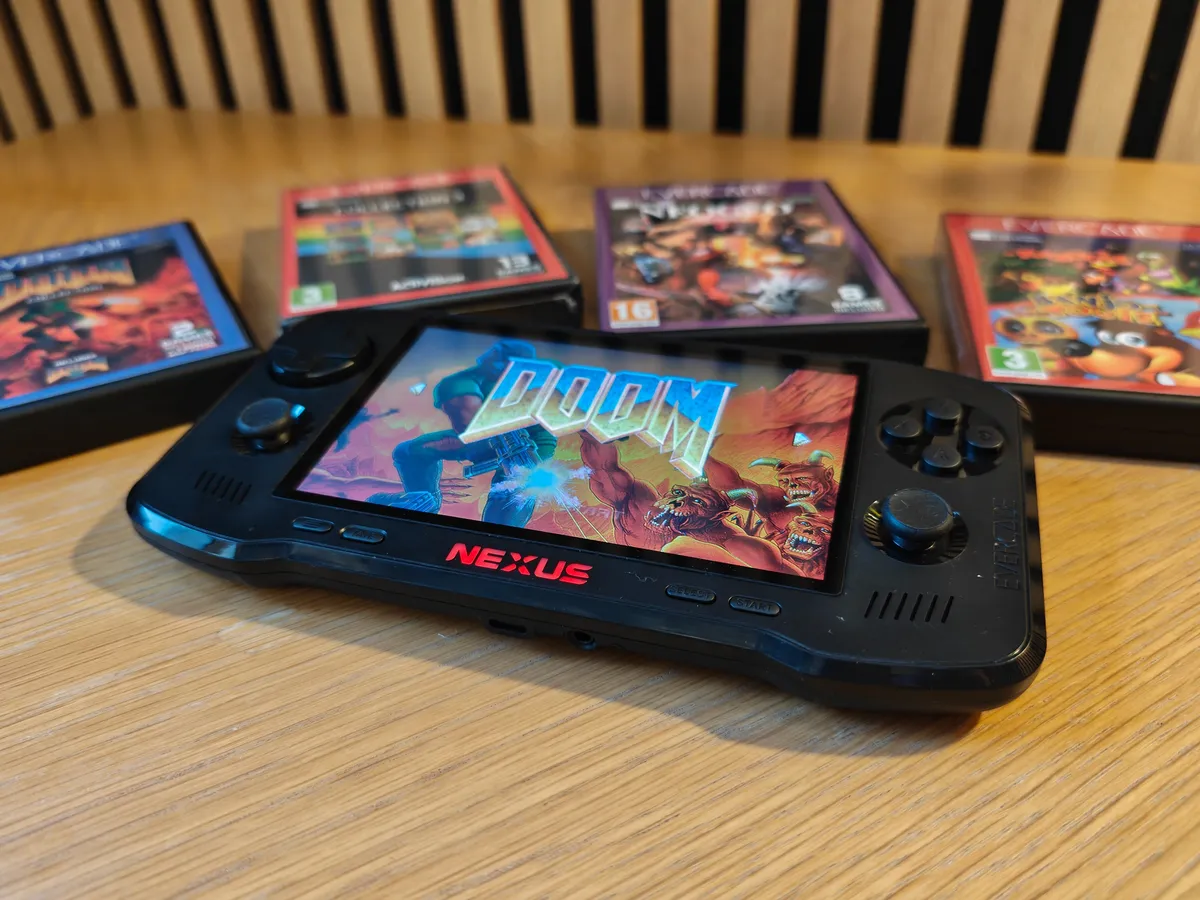
The display keeps up with faster games, too. I've been flipping between the new DOOM and DOOM II collection and the SNK titles on the new Neo Geo Arcade 4 cartridge I always drift back to because Metal Slug 4 is just too good, and the Nexus handles both. Twin sticks make DOOM feel far more natural than a D-pad ever could, and placing them symmetrically works wonders.
TATE mode is back as well, rotating the screen for vertical arcade games. The Nexus's larger size makes this mode easier to use, as I often found the Evercade EXP a little too narrow to be comfortable. The Nexus's bulk makes it a tad better than the Switch 2 for TATE mode, as I found when playing the Toaplan Arcade Garage: Flying Fire Shark; Nintendo’s console can be too slim for its own good.
The cartridge collection remains the real star
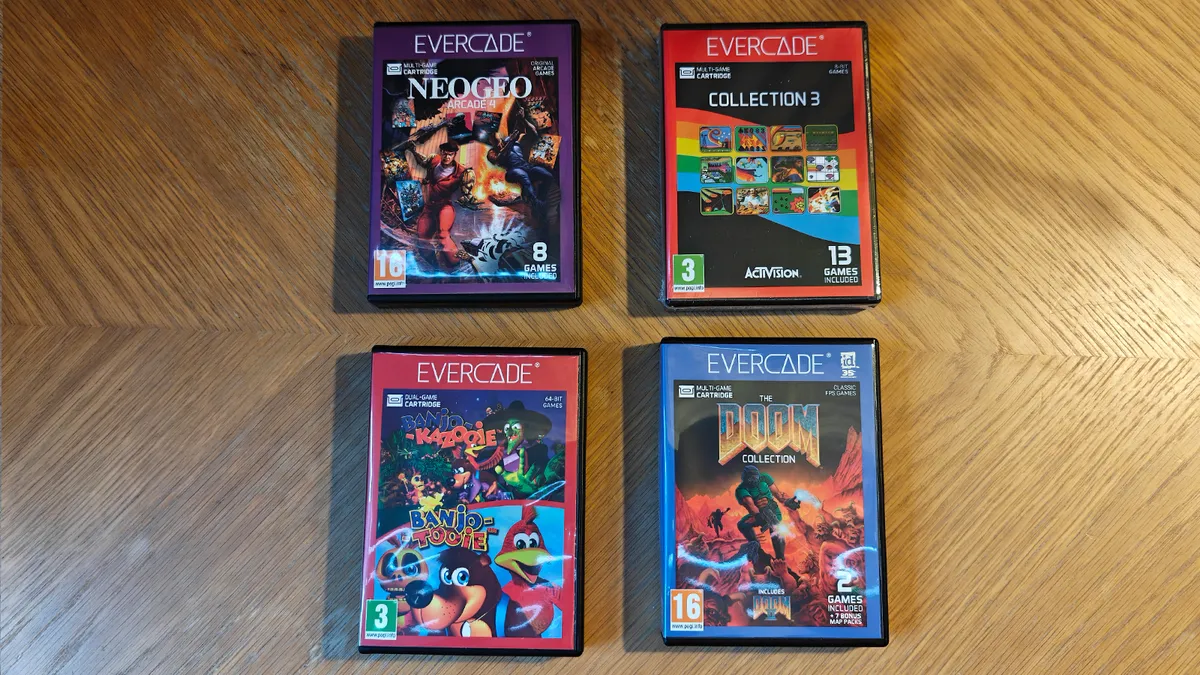
The Nexus is only half the story, of course, because Evercade's physical games are the main draw, and the new handheld plays the entire existing library: more than 80 cartridges and over 700 officially licensed games from Atari, Capcom, Taito, SNK, Rare, Activision and more. Each collection arrives in its own box with a full-colour manual, and building a shelf of them is a joy a digital storefront can't match.
No downloads, no games vanishing from a subscription service, no hunting for ROMs in dodgy corners of the internet. Cart in, game on. It's refreshing and plays into the idea of celebrating how we play and not just what we play, and by plan or by accident. Evercade has become the zeitgeist brand, treating gaming like a vinyl collection.
The Nexus also debuts EverSync, a local wireless multiplayer feature. Only one player needs the cartridge; the second console receives the game from the first. It's clever, and it makes owning physical games feel more flexible and inclusive, but it also reminds me of how we used to play back in the day, when you’d share games and play on the couch. You'll need a second Nexus, though, so maybe part of Evercade is happy playing by 2026’s rules.
What's missing from Evercade Nexus?
Two omissions stand out. The big one is HDMI. The original Evercade EXP had a Mini HDMI port; the Nexus is strictly a handheld. You can't plug it into a TV or use it as a portable home console like some rivals.
I get why. Evercade already has the VS and VS-R for TV play, and there's a business case for keeping the products apart. It's still a shame if you want one device to do everything.
The other gap is a proper sleep mode. There's no suspend and resume, so you power down and restart every time you put it away. That feels odd on a modern handheld, especially if you're used to picking up a Switch and jumping straight back in. Boot times aren't speedy either, at around 40 seconds (I know, we're in such a low attention span era, how did I survive ZX Spectrum tape-loading?), so I'd love to see a fix in a future update.
Neither is a deal-breaker. Both remind me that the Nexus is a focused console, and Evercade has clearly balanced features and specs to make it affordable.
Should you buy the Evercade Nexus?
Yes, if you want retro gaming without the faff. The Evercade Nexus is the best version of what Evercade has been building towards: comfortable, well-made, with a big screen and a huge library of classics from day one that's dead easy to play.
I like that Evercade hasn't pushed the hardware too far. Banjo-Kazooie shows what the Nexus can do in 3D, and the 8-bit and 16-bit games that built the brand are still right at home.
At $199.99 / £169.99 for the base console ($229.99 / £189.99 for the 64 Edition and $249.99 / £199.99 for the Doom Edition), it isn't competing with cheap emulation handhelds, and it's not directly competitive with Switch 2. The lack of OLED, HDMI and sleep mode will put some people off, but those are clearly choices made to keep Nexus affordable and dodge a headlong fight with Nintendo.
Evercade is selling something different: a curated, licensed, and collectable way to play some of the best games from past arcade and console eras. If you already own cartridges because you have an EXP-R or VS-R, the bigger screen and twin sticks make this a tempting upgrade. If you're new, it's still an easy recommendation.