





We've seen some impressive optical illusions here at Creative Bloq, from rotating horses to Mario on the moon and the existence or not of the colour purple. Yet still new ones come along that reveal new examples of how our eyes can deceive us.
In fact, there's a competition dedicated to the discovery of optical illusions, and it's recently revealed this year's winner. The Best Illusion of the Year Contest has bamboozled us before, and this year's choice is another mind bender, as you'll see in the video below.
Think the gear on the right is moving faster than the one on the left? Think again.
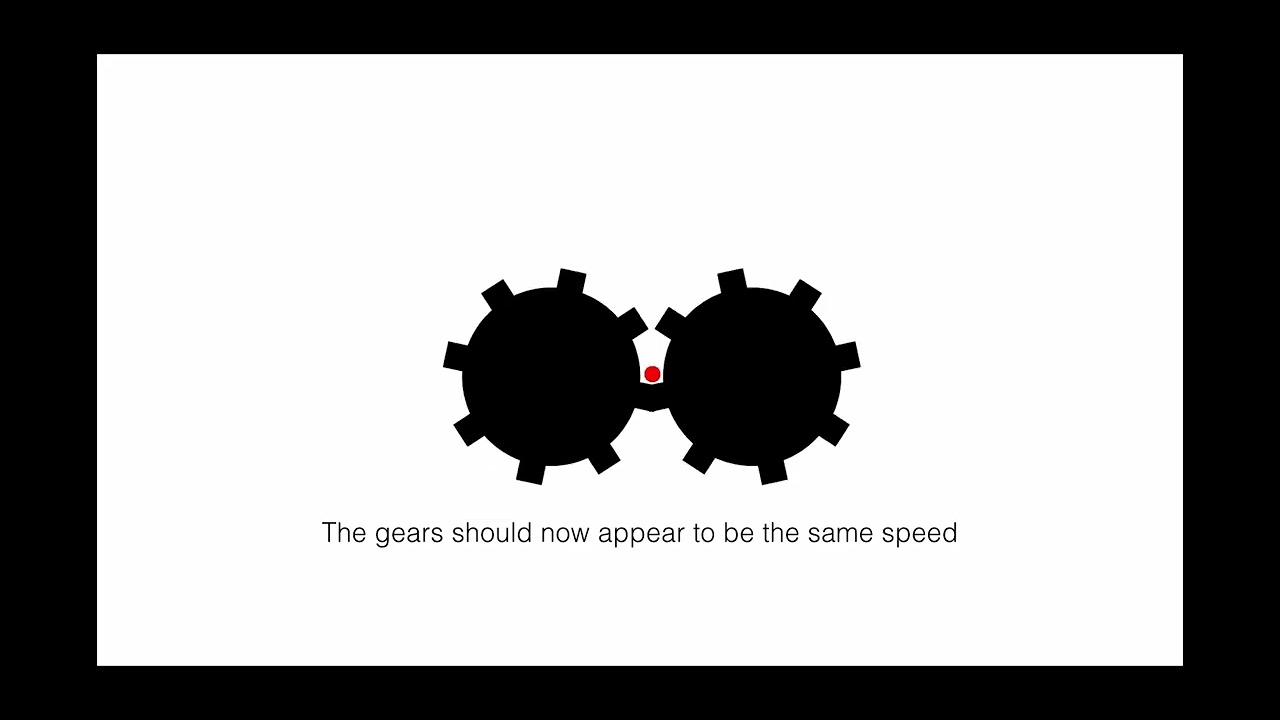
The winner of the Best Illusion of the Year Contest was submitted by Jacky Z. J. Yueh and Joan Danielle K. Ongchoco from the Perception and Cognition Lab at the University of British Columbia in Canada.
Their video above shows two gears that are rotating at the same speed. But if you focus on the white dot on the left gear, you'll probably think that the other gear (the one on the right) is moving faster.
If you focus in the centre of the screen between the two gears, however, the effect disappears. You realise that they're moving at the same speed.
The explanation is that our peripheral vision is more sensitive to motion. This is due to specialised cellular structures and faster neural pathways in the retina and brain. This had a potential evolutionary advantage in that it helps us detect movement in the corner of our eye, which could alert us to a potential threat.
But the winning experiment goes on to show that it's possible to confuse our minds even more. When the position of one gear is adjusted slightly to make it look like it is causally connected to the left one, and we again focus on the white dot, it now looks like the gear on the right is rotating even faster than before.
The conclusion is that perceived causal mechanics, even if they're not real, can altar our perception of dynamic properties, such as speed.
The Best Illusion of the Year Contest is a celebration of illusions and perception run by the Neural Correlate Society. It sees the study of illusions as critical to how we understand sensory perception, and many ophthalmic and neurological diseases too.
Previous winners of the contest have included a stunning Harry Potter Platform 9 3/4 optical illusion.