Bambu Lab has just launched a brand new filament range, PLA Pure, that is certified compliant with EU 10/2011, as well as passing EN 71-3 certification for toy safety. This is actually quite a big deal and sets an excellent benchmark for indoor‑air quality and food-contact safety in the 3D printing industry.
Many people who own some of the best 3D printers won’t be actively aware of potential dangers that include airborne chemical emissions, fire hazards, and toxic raw materials from printing at home.
But, if you’re a crafty maker of any kind and based in the UK (like me), then you may be familiar with strict rules around UKCA /CE testing for 3D prints that specifically appeal to children – i.e flexi dragons, fidgets, or figures – and have what's referred to as "play value".
• Check out the Bambu Lab Anniversary sale live right now

I’ll be honest, it took me a minute to get my head around UK Conformity Assessed (UKCA) testing for 3D printed toys, and I hadn’t even heard of it until recently, but it's very important and legally mandatory.
From my understanding, you can self-test your products and keep a hefty folder of paperwork to ensure that you’re compliant. Part of the testing process requires that your filament is certified safe for kids, passing EN 71-3 chemical testing resulting in a certificate as proof – which Bambu Lab is providing makers for free (see attached PDF).

Usually, if you're looking to get your filament EN71-3 tested for UKCA certification, you'll need to send it away to a lab yourself (which can be costly) or buy a certificate from sources such as 3DCertHub for a pretty cheeky price of up to $30/ £30 per filament brand, not including speciality filaments like silk, matte, or sparkle.
These online 3D printing groups (including Facebook communities) have pooled resources and funds to get filaments privately tested, which is a great idea, though I can't help but feel some are pushing their luck a little and charging a hefty sum for documents that should ideally be free from the manufacturer.
With this in mind, I contacted Bambu Lab to ask if there was an EN71-3 certificate for its new Pure PLA, and alas, here it is! FOR FREE (you can thank me later).
The price of Pure PLA is $24.99 / £22.99 with a spool or $21.99 /£19.99 as a refill, and is currently available in the colours Baby Blue, Milky Pink, Apricot, Pure White, and Absolute Black.
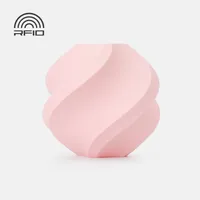

The technical bits: All ingredients of the new Pure PLA filament from Bambu Lab appear on the EU 10/2011 positive list intended for food contact, with a traceable FCM (Food Contact Material) substance number. Testing of printer emissions, particle, and VOC levels was carried out on Bambu Lab A1 and A2L 3D printers.
The foundation of the new filament draws on materials you encounter in everyday life, such as PLA derived from corn and sugarcane, plus acrylic copolymer usually found in children's toys, colour pigments that are commonly used in baby tableware, EBS from food packaging, and asbestos-free talc found in biodegradable drinking straws.

For makers, this means that if you're hoping to become UKCA compliant, a big part of the self-certifying process just got a lot easier if you stick to using Pure PLA. There are, of course, other filament brands that have been EN 71-3 tested, but according to my contact at Bambu Lab, "PLA Pure is currently the only filament in the Bambu Lab lineup that has undergone EN 71-3 testing".
It's worth noting that using PLA Pure and having a certificate is not enough to be classed as UKCA compliant. The procedure also requires keeping track of batch numbers in case of product recall, and physical EN71-1 performance testing with weights and drop tests to identify small parts, choking hazards, and sharp edges.

EN71-2 concerns flammability, mostly for soft toys or items that may be hugged (refer to sources like the Handmade Toys Collective for additional info).
As Bambu Lab puts it, with any 3D-printed toy, common sense still applies. "PLA Pure provides a fully documented ingredient profile, but the rest of the decisions are yours to make with confidence".
I'm in the early stages of my journey to becoming UKCA compliant (there is A TON of paperwork), but I'm thrilled that companies like Bambu Lab are also acting responsibly and taking accountability for manufactured materials that are used in a home environment as well as by small businesses.